There's a few changes over the next few weeks so please read the following information to get up to speed.
This Friday will hold the last adult indoor class in order to meet the demand for more junior classes, so if your 16+ and want an indoor space to train, you'd better get in this week before it's too late! We'll be having a night devoted to obstacle coursing and challenges.
We will not be holding any classes on Good Friday and will return the week after with a second junior class in place of the later adult session, schedule below.
March:
Wed 25th - Adult Outdoor
Fri 27th - Junior Indoor from 6pm, Adult Indoor from 7:20pm.
April
Wed 1st - Adult Outdoor
Fri 3rd - NO CLASSES
Wed 8th - Adult Outdoor
Fri 10th - Indoor Junior: Class 1 from 6pm and Class 2 from 7:20pm.
As ever, all classes need to be booked online via www.southendparkour.com - click "book online" to book up to a month in advance.
Keep up to date by following us on: FACEBOOK, TWITTER, YOUTUBE and INSTAGRAM for exclusive offers, competitions and updates.

Tuesday, 24 March 2015

Tuesday, 17 March 2015
17th March 2015: Move and play.
Wanted to post up real quick, a link to a new video on our youtube page, if you haven't done so already, head on over to www.youtube.com/southendparkour and click subscribe!
Parkour as a massive practice and as much as training (real, hard work) is important to build the "suit of armour" to keep the body strong and safe to continue moving, spending time playing and experimenting is also a key component in experiencing unplanned situations and the chance to test and examine areas of weakness in a fun context.
More fun, more movement, don't underestimate the power of learning in play.
CLICK THE PLAY ICON BELOW TO WATCH THE VIDEO.
Parkour as a massive practice and as much as training (real, hard work) is important to build the "suit of armour" to keep the body strong and safe to continue moving, spending time playing and experimenting is also a key component in experiencing unplanned situations and the chance to test and examine areas of weakness in a fun context.
More fun, more movement, don't underestimate the power of learning in play.
CLICK THE PLAY ICON BELOW TO WATCH THE VIDEO.
Post by Southend Parkour.
Tuesday, 3 March 2015
3rd March '15: Risk taking and Parkour Part 1.
The purpose of this and following posts is to discuss risk exposure within Parkour and further explore how we should look at including it as a community. I aim to discuss current "trends" in the community and look toward exploring effective methods to train smarter with regards to risk and safety. Everything we do in life revolves around balance and we need to work with this ideal to find how to most effectively be exposed to it yet remain safe enough to be able to grow, be safe and have ability to continue to do so in life.
Re-establishing the practice:
Re-establishing the practice:
Parkour is a training practice to overcome obstacles with movement, moving better for life, function and purpose. Obviously, globally we all train for different reasons based on our experiences and goals, but the majority of practitioners who I believe to have a healthy grasp on Parkour channel to a common focus, working towards the ideals of being useful, being able, ensuring safety and having fun. I'd argue that safety and readiness (being able in X or Y situations) are two of the most important areas of focus for training Parkour.
If you are unsafe or make unsafe choices, you increase risk of error or injury; if you are on the floor hurt, you aren't a very effective mover. As such being unsafe opposes the idea of training Parkour, to move. Safety is subjective but I'll discuss this later on.
As for readiness, the inability to practically execute and apply a skill is equally as concerning, especially in a high-stress, real-life situation. I agree with the ideal we need to train to work and act for the unexpected, the challenging, the real, the "scary", but we need to be smart about how we train that and what that looks like. Our training must be varied and introspective enough to look at our own areas of weakness and build our training types/frequency to acquire those skills/improvements/experience.
If you are unsafe or make unsafe choices, you increase risk of error or injury; if you are on the floor hurt, you aren't a very effective mover. As such being unsafe opposes the idea of training Parkour, to move. Safety is subjective but I'll discuss this later on.
As for readiness, the inability to practically execute and apply a skill is equally as concerning, especially in a high-stress, real-life situation. I agree with the ideal we need to train to work and act for the unexpected, the challenging, the real, the "scary", but we need to be smart about how we train that and what that looks like. Our training must be varied and introspective enough to look at our own areas of weakness and build our training types/frequency to acquire those skills/improvements/experience.
"Fear makes men forget, and skill that cannot fight is useless." — Brasidas of Sparta
As a newer practice we do need to continue to discuss Parkour; challenge what we do and how we do it. We can always improve in training and the practice itself is not exempt from this.
As a newer practice we do need to continue to discuss Parkour; challenge what we do and how we do it. We can always improve in training and the practice itself is not exempt from this.
Origins of the Misconception: A big misconception about Parkour is that a large part of the practice is about working at height, doing things over drops etc. Documentaries such as Jump London/Jump Britain/earlier TV interviews shared Parkour at height as a blend between practice exposure, spectacle and art (film). It utilised spaces clearly not designed for people moving across to create spectacle and share levels of competence/ability. As such, the notion of height progressed in the masses because of the reach and focus of the films via mainstream TV and the evolution of YouTube.
The current trend: Rooftop photography, filming: Early Parkour footage coupled with a lack of understanding/care for the practice alongside comparisons to other traditional sports/activities which often revolve around competition (leading to greater need to show, do bigger, faster etc), has in my opinion, lead to the recent growing culture within Parkour or people linked to it partaking in "roof missions"/ "crane climbing” etc, often seemingly with a primary motivation of filming/photography and exposure via social media.

(Image taken from http://www.fubiz.net/wp-content/uploads/2011/05/rooftop-photography12-550x355.jpg)
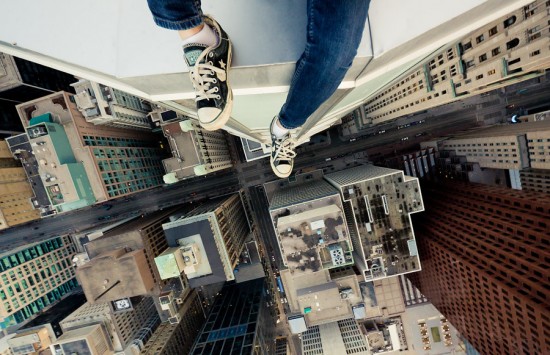
Please note: My concern is always and will always be for the safety of practitioners, current and future, alongside the development of Parkour in the UK. Please read with an open mind and lets think about what we do and why. Since the dissipation of the online forum aspect of the Parkour community, there has been a reduction in exploring and understanding mentality of the practice, the hows, the whys, the reasoning behind our actions.
Alongside the majority of very experienced practitioners I engage with, it is agreed that the recent prevalence of trespassing and high level climbing, being shared via video is concerning for the practice, students and the continued growth of Parkour. I do not and will not condone this practice for several main reasons which I will explore over this and future posts and I'd encourage you to explore this in your own training, choices, or for you to understand and discuss with your son/daughter if you are the parent/guardian of a practitioner.
ANYONE, can grab a camera, climb something, film it, slap it up on YouTube and call it whatever they want. Just because it's labelled with "Free-running" or "Parkour", it doesn't mean it is, so look at everything with a critical eye. Competence does not eliminate risk and does not make you bulletproof. Just because you can, it doesn't mean you have to or should, risk in this area isn't just about YOU damaging YOURSELF but damage to the practice also.
Climbing a ladder and most 'climbing' shared that I've seen as a part of this trend is a very broad basic skill, it is very simple and something which small children do naturally, but are often discouraged from doing. These movements are not and should not be considered categorically, a highly evolved skill and thus carried out by an advanced or skilled individual. Just because something isn't seen often, doesn't immediately mean it is complex or 'special' in terms of an individual's ability. People have jobs that climb daily, tree-fellers, window cleaners for skyscrapers, fire-service etc, whether they've had particular training or not, they are achievable trainable skills, we can all do this with time and practice. Climbing more difficult things is obviously harder and may be a better indicator of skill, however, there are a few things that should be considered as a practitioner of a community.
We live in a society of fear, which is almost as much of an issue to as the carefree and naïve idea that we should climb and do what we can just because we can. The uninformed share the misinformed.
Take this example:
Take this example:
1: 2 Metre High, Two-footed jump - Landed quietly, balanced and good posture.
2: 200 Meter High Two-footed jump - Landed without absorbing impact, poor posture etc.
It's fairly obvious that the 'skill' is seen in the smaller, so why the need to do the same at height poorly? For the sake of filming? What kind of message are we sharing?
Some would argue it shows the mental toughness/resilience, confidence in ability to do it in a high stress scenario; to an extent I'd agree with this, but at what cost?
Is the cost of the risk or falling from height, worth the gain of achieving the same movement execution elsewhere? Is it worth the cost of possible arrest, being the cause for copycats to try and fail, being the very reason for your own/others’ injury or worse. Is it worth the cost of contributing to poor "non-practitioner" understanding continuing to make what we do harder?
Each of our actions have reactions whether you want to accept it or not.
Each of our actions have reactions whether you want to accept it or not.
The masses want spectacle, but I feel as practitioners, we should oppose this viewpoint and reach for more, share a different perspective. We could do things for our own self gain or help people change in their approach and perspective. Bring them into the discussion rather than giving a viewpoint to them, contributing to the evolution of understanding over more of the same.
Doing things for the sake of filming, to replicate, or just to follow another, out of an esoteric notion of "freedom" and "rebellion", is concerning, naïve and will lead to further serious cases which will leave gaps in people's families and friend circles. To get people paying attention to the issues that really matter, I'd argue would be a better, stronger and more worthwhile use of time.
If we as practitioners helped others to learn to appreciate the 'small' movements, the intricacies of movement, valuing mastery and consistency over mass/ or size, society/communities as a whole wouldn't feel the need to take potentially giant risks to validate themselves and their self-worth.
Parkour is as much about changing ourselves as it is helping others (being able and ready). Non-practitioners are overexposed in the “look at me” celebrity culture creating detachment and separation.
Parkour and it's practice is about RECONNECTION, joining us back to movement, back to fundamentals, back to basics, which are so often overlooked and dismissed. I think taking Belle’s approach of “reaching back and help another” is the change we CAN make as practitioners, encouraging others to join and contribute in movement (and Parkour's on-going development) rather than just view the spectacle.
The more people in the loop, understanding what it is we do, the more we can do, the more provision and the greater lives we can leave, partaking in accessible physical activity with a shared understanding. Personally, I will continue to train the small things to better the big picture for myself and for others and at the least I'd love for you to look at your training, your choices and think, what can we do for the better of this amazing discipline.
A similar linked post from our friends at Train-Hard Parkour - http://train-hard.org/2015/03/03/climbing-cranes-and-really-long-ladders/
If we as practitioners helped others to learn to appreciate the 'small' movements, the intricacies of movement, valuing mastery and consistency over mass/ or size, society/communities as a whole wouldn't feel the need to take potentially giant risks to validate themselves and their self-worth.
Parkour is as much about changing ourselves as it is helping others (being able and ready). Non-practitioners are overexposed in the “look at me” celebrity culture creating detachment and separation.
Parkour and it's practice is about RECONNECTION, joining us back to movement, back to fundamentals, back to basics, which are so often overlooked and dismissed. I think taking Belle’s approach of “reaching back and help another” is the change we CAN make as practitioners, encouraging others to join and contribute in movement (and Parkour's on-going development) rather than just view the spectacle.
The more people in the loop, understanding what it is we do, the more we can do, the more provision and the greater lives we can leave, partaking in accessible physical activity with a shared understanding. Personally, I will continue to train the small things to better the big picture for myself and for others and at the least I'd love for you to look at your training, your choices and think, what can we do for the better of this amazing discipline.
A similar linked post from our friends at Train-Hard Parkour - http://train-hard.org/2015/03/03/climbing-cranes-and-really-long-ladders/
Saturday, 31 January 2015
1st February '15: Hands and Feet!
You were born to move.
Quadrupedal movement is an excellent training tool to engage both body and mind in physical (re)education. Research by Herbert, Gross and Payne (2007) suggests that crawling movement aids in memory development in infants moving earlier than others.
There may well be limited carry over into adults, and there is a lack of research in the area of QM for adults (understandably) however, it stand to reason that being able to work and move effectively using 4 limbs, consciously rather than 2 (just legs) may engage your body and mind in a more challenging way compared to using less of your body at any given time.
From experience, quad movement brings on the sweat, makes the lungs and heart work hard and forces you to be more conscious in your movement, especially when moving slower, deliberately place each foot, hand and body part to move yourself. Coupling this with balancing on or in smaller spaces adds an extra element of difficulty which is a recommended progression for improving movement ability.
One such exercise I've been developing and training is making an assortment of rail/bars/beams and forcing yourself to keep moving in the, without touching the groun, using your arms as much as you would your legs, try even a minute of movement in this manner and you'll see what I mean. In spending more time in this type of movement progressively, you're develop wrist, forearm, bicep/triceps, shoulder and surrounding musculature strength/ability simply by spending more time in more movement patterns, supporting and controlling your movements with upper body limbs.
The more experience in movement, in different rotations, directions and stances, the better your ability to apply yourself to a new or similar situation as and when they occur.
In the grand scheme of movement, we're more likely to need to move on our feet and use our hands/arms secondarily but as for training and learning, give it a go.
Crawl more, move more and have fun!
Ref:
http://www.ncbi.nlm.nih.gov/pubmed/17286842
http://www.apexmovement.com/blog/crawl-like-a-baby-5-reasons-to-add-quadrupedal-movement-to-your-workout/
There may well be limited carry over into adults, and there is a lack of research in the area of QM for adults (understandably) however, it stand to reason that being able to work and move effectively using 4 limbs, consciously rather than 2 (just legs) may engage your body and mind in a more challenging way compared to using less of your body at any given time.
From experience, quad movement brings on the sweat, makes the lungs and heart work hard and forces you to be more conscious in your movement, especially when moving slower, deliberately place each foot, hand and body part to move yourself. Coupling this with balancing on or in smaller spaces adds an extra element of difficulty which is a recommended progression for improving movement ability.
One such exercise I've been developing and training is making an assortment of rail/bars/beams and forcing yourself to keep moving in the, without touching the groun, using your arms as much as you would your legs, try even a minute of movement in this manner and you'll see what I mean. In spending more time in this type of movement progressively, you're develop wrist, forearm, bicep/triceps, shoulder and surrounding musculature strength/ability simply by spending more time in more movement patterns, supporting and controlling your movements with upper body limbs.
The more experience in movement, in different rotations, directions and stances, the better your ability to apply yourself to a new or similar situation as and when they occur.
In the grand scheme of movement, we're more likely to need to move on our feet and use our hands/arms secondarily but as for training and learning, give it a go.
Crawl more, move more and have fun!
Ref:
http://www.ncbi.nlm.nih.gov/pubmed/17286842
http://www.apexmovement.com/blog/crawl-like-a-baby-5-reasons-to-add-quadrupedal-movement-to-your-workout/
Friday, 9 January 2015
9th January '15: Why Learn Parkour?
Short post to explore 5 reasons for learning Parkour, they may not be what you think but hopefully they will help you understand what we're about and what Parkour and you, can do!
1. Health
Globally, the majority of us we are sitting or still for most of the day. Sedentary lifestyles increase a variety of health issues, we're not doing what we're built to do, MOVE!
We're built to walk, run, climb, vault, squat, lift, carry and chase. Not doing so leads to a 'wealth' of health issues which more often than not, shorten the quality of our lives.
By moving more and realising where (using our surroundings) and how we can move (using our bodies safely), we start a journey towards doing what we're built to do, rekindling not only our ability to move, but our physical fitness ability and overall health.
1. Health
Globally, the majority of us we are sitting or still for most of the day. Sedentary lifestyles increase a variety of health issues, we're not doing what we're built to do, MOVE!
We're built to walk, run, climb, vault, squat, lift, carry and chase. Not doing so leads to a 'wealth' of health issues which more often than not, shorten the quality of our lives.
By moving more and realising where (using our surroundings) and how we can move (using our bodies safely), we start a journey towards doing what we're built to do, rekindling not only our ability to move, but our physical fitness ability and overall health.
2. Safety
We're all familiar with the "fight or flight" state, in a high stress situation our mental and physical response to a stressor is to either run away or fight to survive (We are built to move)!. Although these situations may be rare in the UK or "civilised society", things do still happen; fires, attacks, the need to chase, the need to reach, the need to escape.
We're all familiar with the "fight or flight" state, in a high stress situation our mental and physical response to a stressor is to either run away or fight to survive (We are built to move)!. Although these situations may be rare in the UK or "civilised society", things do still happen; fires, attacks, the need to chase, the need to reach, the need to escape.
Martial arts are a common practice in the UK, having dabbled in Wing Chun, Ninjitsu and Krav Maga, to varying degrees, we're often told, "Run first, but if you can't, as a last here's how to defend yourself."
Parkour develops the first part and is, in our opinion, as important as being able to handle yourself up close. As a practical example, a friend had a knife pulled out on him, he could immediately vault a rail safely and had a barrier between the attacker and him. Parkour is great for self defence, run, escape and move! If you've not practised escaping, running or vaulting under pressure, if your slip and are hurt, the attacker has you anyway... it makes sense to practice the art of escape.
Practising Parkour and movement also allows you to deal with mistakes better, through knowing your body and how to move. Most times when I fall, slip etc, my training enables me to avoid injury and still land safely, living to "flight" another day!
We all make mistakes and will fall, Parkour tends to help us be safe doing so!
Practising Parkour and movement also allows you to deal with mistakes better, through knowing your body and how to move. Most times when I fall, slip etc, my training enables me to avoid injury and still land safely, living to "flight" another day!
We all make mistakes and will fall, Parkour tends to help us be safe doing so!
3. Fun
Parkour is fun! A big deterrent from most forms of exercise is that it can be quite boring, obviously it's perspective, but lots of individuals who try Parkour, latch onto it and continue. Competitive sports tend to focus your performance on other's ability, Parkour is different in that it accepts that we are all unique, we all have strengths and weakness and all move differently.
You can't accurately compare yourself to another because you are and will be different! In training we move and explore, finding new challenges, new spaces, new situations to grow and develop.
There is no ultimate "right or wrong" with Parkour as a practice, only what works for you and your movement in a given situation. We learn through challenges: personally and externally set; we learn through imagination and games: Playing "Stay off the ground" and similar games/ scenarios.
Because we are all unique, we can set our own goals, to move towards them at our own pace and ensure our own safe and fun progression.
You can't accurately compare yourself to another because you are and will be different! In training we move and explore, finding new challenges, new spaces, new situations to grow and develop.
There is no ultimate "right or wrong" with Parkour as a practice, only what works for you and your movement in a given situation. We learn through challenges: personally and externally set; we learn through imagination and games: Playing "Stay off the ground" and similar games/ scenarios.
Because we are all unique, we can set our own goals, to move towards them at our own pace and ensure our own safe and fun progression.
4. Benefits of Challenge
We face challenges daily in all areas of our, work, personal, social and recreational lives. In training and overcoming obstacles we have to apply our physical and mental being to overcome, practising practical problem solving skills. We physically and mentally overcome these challenges, we achieve.
Through achievement, we gain confidence, building an "experience backpack", a collection of challenges faced and overcome, which we can apply to future challenges faced.
People who practice Parkour tend to have a very similar attitude and approach to life in that things can be done and problems can be solved. Even if we don't know, we still try (as long as it's safe to do so), in turn, gaining experience and apply to our future personal conquests!
We face challenges daily in all areas of our, work, personal, social and recreational lives. In training and overcoming obstacles we have to apply our physical and mental being to overcome, practising practical problem solving skills. We physically and mentally overcome these challenges, we achieve.
Through achievement, we gain confidence, building an "experience backpack", a collection of challenges faced and overcome, which we can apply to future challenges faced.
People who practice Parkour tend to have a very similar attitude and approach to life in that things can be done and problems can be solved. Even if we don't know, we still try (as long as it's safe to do so), in turn, gaining experience and apply to our future personal conquests!
5. Adaptability
Being an adaptable person is a very useful skill/personality. Tying in with some of the areas mentioned above Parkour practitioners, seek, try, gain experience, reflect and apply what has been learnt, what works and what doesn't work, to future challenges both mentally and physically.
As such, Parkour tends to aid people in other sports and other physical activities from having a good experience and understanding of movement. There is a mindset developed through practice, to very quickly risk assess, problem solve and develop creative solutions to problems or challenges presented. In a world where change is an integral part of society; jobs, lifestyle, time, family, friends, technology, having the confidence to adapt and change yourself is something many people can struggle with.
To quote Sebastien Foucan, In overcoming, we become.
START YOUR JOURNEY! Join us for a class or if you have any questions, please visit www.southendparkour.com
Being an adaptable person is a very useful skill/personality. Tying in with some of the areas mentioned above Parkour practitioners, seek, try, gain experience, reflect and apply what has been learnt, what works and what doesn't work, to future challenges both mentally and physically.
As such, Parkour tends to aid people in other sports and other physical activities from having a good experience and understanding of movement. There is a mindset developed through practice, to very quickly risk assess, problem solve and develop creative solutions to problems or challenges presented. In a world where change is an integral part of society; jobs, lifestyle, time, family, friends, technology, having the confidence to adapt and change yourself is something many people can struggle with.
To quote Sebastien Foucan, In overcoming, we become.
START YOUR JOURNEY! Join us for a class or if you have any questions, please visit www.southendparkour.com
Saturday, 3 January 2015
31st December 2014 - Out with the old...
First of all, I'd like to thank all of the support so far and throughout the end of 2014. It's always inspiring to see younger, older, new and experienced practitioners involved with our classes and services. As much as we've only been officially trading since October, we've been involved in Parkour in one entity or another for well over a decade, having had the opportunity to travel and coach all across the UK and abroad.
Following the announcements below it will become increasingly important to keep connected with news as an when it comes. Our facebook account will detail last minute spaces for classes to please ensure you are connected with us for important recent changes. Other unique content is and will be also added regularly via our twitter, instagram, and youtube so please ensure you follow!
Moving forward into 2015, we are please to announce a few new developments:
Firstly: Cheaper Outdoor Classes!
Our weekly adult outdoor class, which explores Parkour in the real work is now open for anyone 16+ (With parental consent) and now reduced to £8 for 2 hours of outdoor, Parkour coaching. These classes put Parkour training where it belongs, out in the open, rain or shine, utilising spaces in Southend to learn, strengthen, challenge, adapt and overcome!
Find out about these on our website www.southendparkour.com/classes
Secondly: We will be adding two new Southend classes from the 16th January 2015!
The first will be a "Junior class" for young people ages 8 to 15 years of age, taking place at an indoor training space in Southend for 1 hour & 10 minutes of Parkour movement development and functional fitness under our expert guidance. 6:00pm til 7:10pm
The second class will follow immediately after for a 16+ (Senior Class) 1 Hour & 10 Minute class, challenging attendees to adapt and overcome through Parkour skill development and functional fitness. 7:20pm til 8:30pm.
Wall frames, ropes, vaults and matting will help support your effective learning. As much as indoor training can't entirely substitute outdoor training, it can provide a great introduction to the practice and you'll still be challenged through fun and engaging guided practice; improving fitness and physical ability with our training.
Finally: We're going digital! You can now sign up and pay online to all of our classes via our new online booking system, booking up to a month in advance!
You can book via our website at www.southendparkour.com/classes, then click the "Book online" button.
Using this ensures we can have spaces filled while not oversubscribing which may make a wasted journey for some. If you have any questions or issues, contact us through the email address listed on the system or contact us through our website, www.southendparkour.com/contact
Please read the information carefully before booking, to ensure correct dates/classes.
We look forward to moving with you this year! Thanks for joining us!
The second class will follow immediately after for a 16+ (Senior Class) 1 Hour & 10 Minute class, challenging attendees to adapt and overcome through Parkour skill development and functional fitness. 7:20pm til 8:30pm.
Wall frames, ropes, vaults and matting will help support your effective learning. As much as indoor training can't entirely substitute outdoor training, it can provide a great introduction to the practice and you'll still be challenged through fun and engaging guided practice; improving fitness and physical ability with our training.
Finally: We're going digital! You can now sign up and pay online to all of our classes via our new online booking system, booking up to a month in advance!
You can book via our website at www.southendparkour.com/classes, then click the "Book online" button.
Using this ensures we can have spaces filled while not oversubscribing which may make a wasted journey for some. If you have any questions or issues, contact us through the email address listed on the system or contact us through our website, www.southendparkour.com/contact
Please read the information carefully before booking, to ensure correct dates/classes.
We look forward to moving with you this year! Thanks for joining us!
Wednesday, 17 December 2014
17th Dec 2014: Last Session of the year TONIGHT
Tonight will host the last Adult Outdoor class of the year between 19:30 and 21:30, for 2 hours of structured Parkour tuition, training and guidance from our certified coach. Join us by messaging us on Facebook or via the website www.southendparkour.com/contact
After tonight we'll be in hibernation on the class front, back with a vengeance in the new year with new classes and more opportunities to learn, improving overall fitness and your ability to overcome new challenges faced.
Details on current and soon, new classes can be found via our website: www.southendparkour.com/classes
Regular updates will be posted throughout Christmas on our facebook, twitter, youtube and instagram.
After tonight we'll be in hibernation on the class front, back with a vengeance in the new year with new classes and more opportunities to learn, improving overall fitness and your ability to overcome new challenges faced.
Details on current and soon, new classes can be found via our website: www.southendparkour.com/classes
Regular updates will be posted throughout Christmas on our facebook, twitter, youtube and instagram.
Subscribe to:
Posts (Atom)